The Astrology Review
How to Read Your Kundli: Lagna, 12 Houses and Planets, Step by Step
A beginner's guide to reading a kundli: find your lagna, read North and South Indian charts, learn the 12 houses, and see what your dasha says.

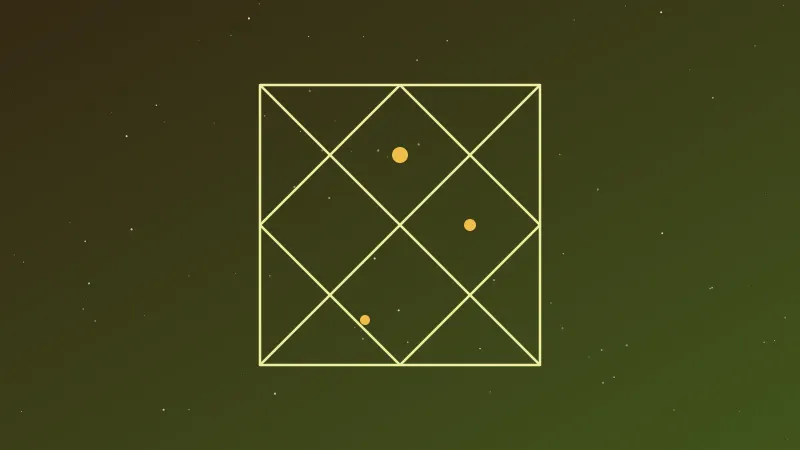
Quick answer: To read a kundli, find the lagna (1st house) first. In a North Indian chart it is the top centre diamond. Count the 12 houses anticlockwise from there. Each house covers an area of life (1st self, 7th marriage, 10th career). See which planets sit in which houses and signs, then check your current mahadasha, which tells you which planet's themes are active now.
Step 1: Find your lagna
The lagna (ascendant) is the zodiac sign rising on the eastern horizon when you were born. It is the 1st house and the starting point for everything else.
- North Indian chart (diamond): houses are fixed. The top centre diamond is always the 1st house, and the number written in it is the lagna sign (1 = Aries, 2 = Taurus … 12 = Pisces). Count the houses anticlockwise.
- South Indian chart (square grid): signs are fixed, with Pisces in the top-left box and the signs running clockwise. The lagna box is marked "La" or with a diagonal line. Count houses clockwise from it.
Step 2: Learn what the 12 houses mean
| House | Called | Main themes |
|---|---|---|
| 1st | Lagna, tanu | Self, body, personality, overall direction |
| 2nd | Dhana | Family, money you keep, speech, food |
| 3rd | Sahaja | Courage, siblings, effort, short travel, communication |
| 4th | Sukha | Mother, home, property, vehicles, inner peace |
| 5th | Putra | Children, intelligence, romance, creativity, past merit |
| 6th | Ripu | Enemies, debt, illness, daily work, competition |
| 7th | Kalatra | Marriage, spouse, partnerships, business deals |
| 8th | Ayu | Longevity, sudden events, secrets, inheritance, research |
| 9th | Dharma | Father, guru, luck, higher learning, long journeys |
| 10th | Karma | Career, status, reputation, authority |
| 11th | Labha | Income, gains, friends, wishes fulfilled |
| 12th | Vyaya | Expenses, loss, foreign lands, sleep, moksha |
Kendras (1, 4, 7, 10) are the pillars of the chart. Trikonas (1, 5, 9) are considered lucky. Dusthanas (6, 8, 12) cover struggle, though they aren't simply "bad".
Step 3: See where the planets are
Each of the nine grahas carries its own themes:
| Graha | Signifies |
|---|---|
| Sun (Surya) | Self, father, authority, government |
| Moon (Chandra) | Mind, mother, emotions |
| Mars (Mangal) | Energy, courage, property, siblings, conflict |
| Mercury (Budh) | Intellect, speech, trade, learning |
| Jupiter (Guru) | Wisdom, children, teachers, growth, luck |
| Venus (Shukra) | Love, marriage, beauty, comfort, arts |
| Saturn (Shani) | Discipline, delay, hard work, longevity |
| Rahu | Obsession, ambition, foreign, the unconventional |
| Ketu | Detachment, spirituality, past karma |
A planet in a house brings its themes to that area of life. Venus in the 7th, for example, is read as warmth in marriage. A planet's sign shows its strength: exalted, own sign, friendly, or debilitated.
Step 4: Find your house lords
Each house is ruled by the lord of the sign in it. If Libra is in your 10th house, Venus is your 10th lord (career). Where that lord sits tells you more. A 10th lord in the 11th links career with income. Beginners can skip this step at first, but it is how astrologers connect the chart together.
Step 5: Check your current dasha
Your Vimshottari mahadasha shows which planet runs this phase of life, and the antardasha shows the sub-phase. If you are in Venus–Jupiter, read the houses Venus and Jupiter occupy and rule. That is where the chart says the action is now. More in real Vedic astrology.
Step 6: Look at Moon sign and nakshatra
Your rashi (Moon sign) is what daily rashifal and Sade Sati are calculated from. Your nakshatra is used for dasha, naming and kundli matching.
What do beginners get wrong when reading a kundli?
- Reading one planet alone. A single "bad" placement is always balanced by the rest of the chart.
- Panicking over doshas. Manglik dosha and others are common, and they have cancellations.
- Confusing North and South charts. Houses are counted in opposite directions.
- Ignoring dasha. A placement shows its results mainly in its planet's period.
Frequently asked questions
Which house in the kundli is for marriage?
The 7th house is the main house of marriage and spouse. Astrologers also look at Venus (for men, traditionally), Jupiter (for women, traditionally), the 7th lord and the navamsa (D9) chart.
Which house is for career?
The 10th house, supported by the 6th (daily work and service) and the 11th (income). The 10th lord and Saturn are also read for career.
What is the difference between rashi and lagna?
Rashi is the sign the Moon was in at birth. Lagna is the sign rising on the eastern horizon at birth. Lagna changes about every two hours, rashi about every two and a quarter days.
Can I read my own kundli without an astrologer?
You can learn the basics (houses, planets, dasha) yourself with a free kundli. Combining many factors into a judgment takes practice, and that is where an astrologer or a good AI app helps.